The Flag Raisers After Dark: Arlington's Memorial on a Washington Night
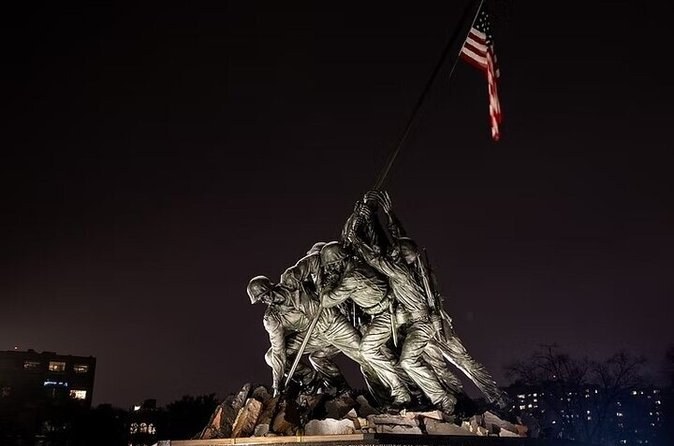
The short answer. The Marine Corps War Memorial stands in Arlington, across the Potomac from the Mall. Its flag flies 24 hours a day by presidential proclamation, so it is lit and flying whenever you arrive. The figures are 32 feet high and the whole memorial about 78 feet. The question is whether your evening crosses the river: several coaches, a van and the private cars stop there, others only drive past, and some never cross. Check this stop when you compare night bus tours.
What you are looking at
Six bronze figures raise a 60-foot bronze flagpole on a rock slope, above a base of granite from Sweden. The figures are 32 feet high. The M-1 rifle one of them carries is 16 feet long and the carbine 12; the canteen would hold 32 quarts of water. Around the base, a gold ring carries the names and dates of every principal Marine Corps engagement since the Corps was founded.
At night the floodlights pick out the figures against the dark and the flag above them. The stop is 10 to 20 minutes on the evenings that make it, about the same as a memorial on the Mall.
The photograph behind it
Iwo Jima is a small island 660 miles south of Tokyo. On the morning of 19 February 1945 the 4th and 5th Marine Divisions landed there. The 28th Regiment of the 5th Division was ordered to take Mount Suribachi, the volcano at its southern tip. The Marines reached the base of the mountain on the afternoon of 21 February and had almost surrounded it by nightfall the next day. On the morning of 23 February, Marines of Company E, 2nd Battalion, began the climb.
At about 10:30 that morning a small American flag was flying from the summit. That afternoon a second, larger flag went up in the same place, and Joe Rosenthal of the Associated Press photographed it. The picture won a Pulitzer Prize. The sculptor Felix W. de Weldon, then on duty with the U.S. Navy, built first a scale model and then a life-size one from it.
The statue was dedicated by President Dwight D. Eisenhower on 10 November 1954, the 179th anniversary of the Marine Corps. Its entire cost, $850,000, was donated by U.S. Marines, friends of the Marine Corps and members of the Naval Service.
The six men, and the two names corrected
Three men posed for the sculptor, who modelled their faces in clay: Rene Gagnon, Ira Hayes and John Bradley. They were then believed to be the survivors of the flag raising. The Marine Corps has since concluded that Bradley and Gagnon were not in the photograph; Private First Class Harold Schultz and Corporal Harold Keller were. The figures stand where the men were identified at the time, and the six are now named as:
| Where on the statue | Who |
|---|---|
| Farthest from the pole, both hands reaching up | Private First Class Ira Hayes |
| In front of Hayes, to the right | Private First Class Harold Schultz |
| In front of Hayes, to the left | Sergeant Michael Strank |
| In front of Schultz | Private First Class Franklin Sousley |
| In front of Strank | Corporal Harold Keller |
| At the foot of the flagpole | Corporal Harlon Block |
Hayes, at the back with both hands reaching up, is the figure to find first; a guide will point out the other five from the base.
Which evenings stop, and which drive past
The memorial is on the George Washington Memorial Parkway, run by the National Park Service. Getting there means crossing the river, which takes a coach out of its loop of the Mall. So check the itinerary, not just the photograph on the listing.
- A stop of 15 minutes: the 7:30pm coach from Navy Memorial Plaza, its glass-top minibus and the coach outside the National Archives. The Heart of DC van from One CityCenter stops for 15 minutes too.
- A stop on the private evenings: the private car from your door gives it 20 minutes. The private minivan gives it 10, and the private car with six stops 15.
- A shorter stop: the coach from the Smithsonian station gives it 10 minutes.
- A drive past: the Signature coach and the moonlight van pass it without stopping.
- Skipped for now: the trolley's 20-minute stop is currently skipped for a bridge closure and replaced with the World War II Memorial.
- Never: the van from the Grand Hyatt keeps all ten of its stops in DC.
Every coach and its stops are compared on our page of night bus tours. The private evenings, which let you ask for more time here, are on the page of private night tours.
Arlington after dark
Next to the memorial, Arlington National Cemetery is open from 8am to 5pm every day, so no evening goes in. Tours that cross the river pass it from the road, and some private cars also pass the Kennedy Center on the way over. If you want to visit the cemetery, it is a daytime trip of its own.
The flag above the memorial flies all night. The rest of the evening's stops, lit and unlit, are on the memorials page, and where each one sits on the map.
When to see it
The flag is always up, but the view changes with the sky. In June a 7:30pm coach reaches Arlington near the end of the evening, after full dark at about 9:07pm. So even in summer, the memorial is one of the stops you see lit. From October to March the whole evening is dark and cold; the base is exposed, so bring a layer. Our month-by-month weather and dark times gives both, and our post on the dark the full table.
For every ride that crosses the river, with its start and its price, see the night tour options page.
Evenings that stop at the flag raisers
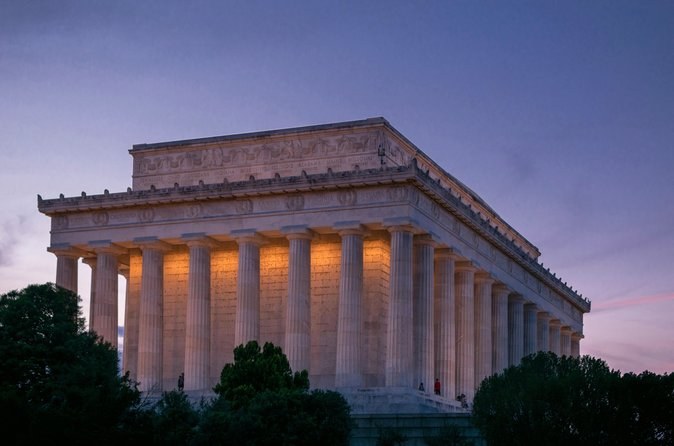
DC Night Tour: 10+ National Mall Monuments, Entry Ticket Upgrades
Three hours by coach from outside the National Archives, arriving by 7pm: nine stops of 15 to 20 minutes with the guide beside you, the flag raisers among them.
From $63 per person
Check Availability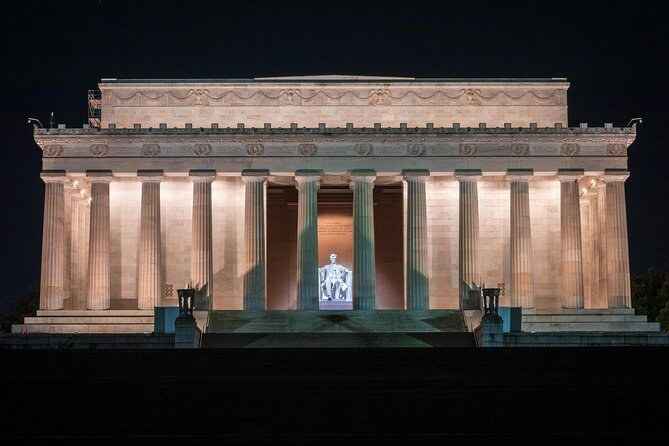
Washington DC Monuments and Memorials Night Tour
Three hours in a van of up to 12 from One CityCenter on 10th Street: nine stops of 15 to 20 minutes, across the river too. Commentary comes by audio link, so bring earbuds.
From $89 per person
Check Availability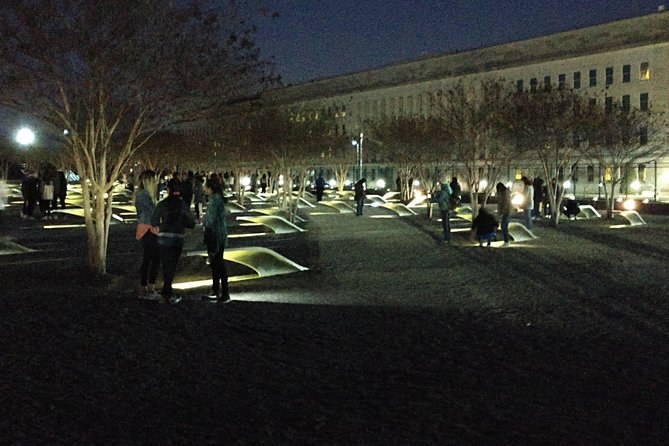
Washington DC Small-Group Evening City Tour
Three hours in a private minivan for up to five, picked up in the city, with six stops including the Pentagon Memorial and the flag raisers. Listed as wheelchair accessible.
From $275 per group (up to 5)
Check AvailabilityNext: Look for the Arlington stop in the itinerary, then book the evening that gives it time on foot. Every fare sits side by side on Washington Night Tours.